
For healthcare organizations in WhatsApp-first markets
The AI care operations platform for WhatsApp-first healthcare.
Patient check-ins, triage, escalation and clinical documentation, run on WhatsApp and supervised by your team.
Built so a care team of three can follow more than a thousand chronic patients.
Live in production
Running the daily care operations of a doctor-led continuous care provider in Pakistan.
Clinically directed
Clinical direction comes from a senior endocrinologist with international standing in the field, not from us.
Built to Meta’s rules
The 24-hour window, template classification and opt-out are enforced by the platform, not by staff remembering them.
The problem
Continuous care is not a clinical problem. It is an operations problem.
A chronic patient spends a few minutes a month with a clinician and manages the condition for the rest of it. The care that decides the outcome happens in between, and almost nobody is staffed for it.
So most organizations pick one of three:
You don’t follow up.
Patients drift, readings go unseen, and the program produces the same outcomes as the episodic care it was supposed to replace.
You follow up by hand.
Your counselors live in a phone inbox and a spreadsheet. Nothing is auditable, nothing is handed over cleanly, and nobody can answer which patients are at risk right now.
You hire.
The most honest option and the most expensive one. Cost per patient never comes down, and you scale a payroll instead of a program.
Hakeem is the fourth option.
How it works
One loop. Every patient. Every day.
This is the system running in production today.
01The check-in goes out
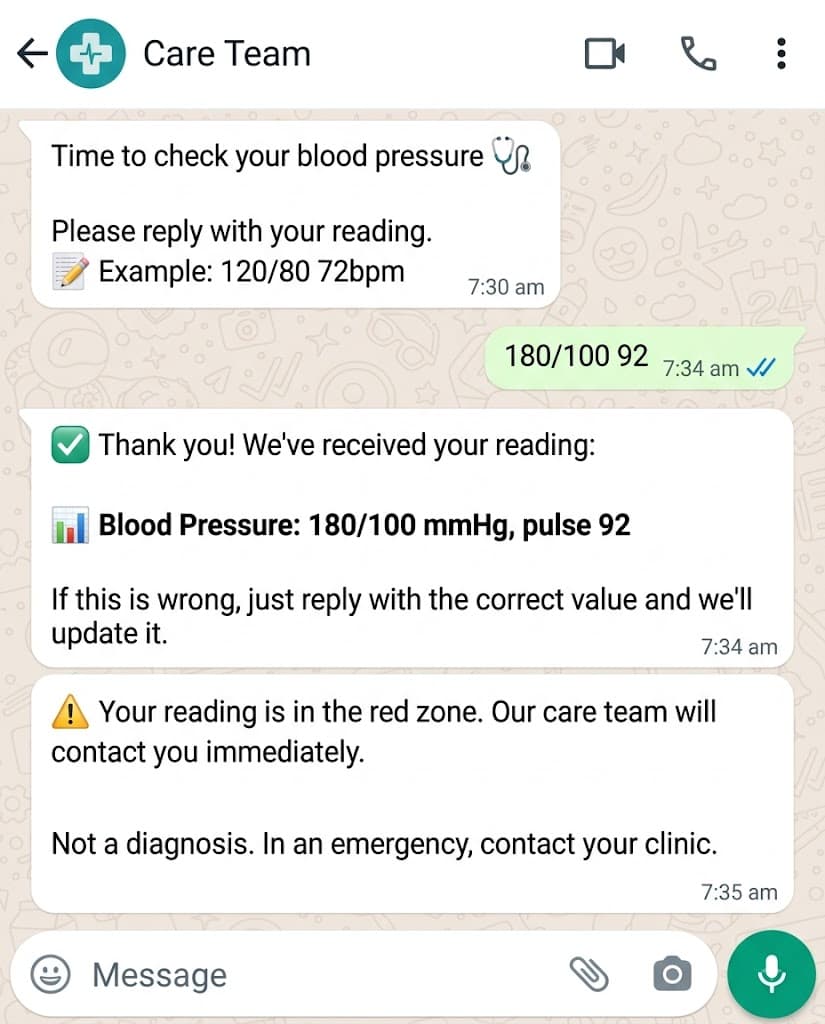
Scheduled WhatsApp templates ask each patient for the readings their care plan calls for. Tappable replies. No app to download, no portal, no password to reset. Patients who are elderly or not comfortable with technology can use it, because they are already using WhatsApp every day.
02The patient replies
In English or Urdu. Every reading is parsed and written to the patient’s record as structured data, not left as a message somebody has to go back and read.
03The reading is scored
Green, yellow or red, against thresholds your clinicians set. The scoring is deterministic and testable. No language model sits in a triage decision.
04Only exceptions reach a human
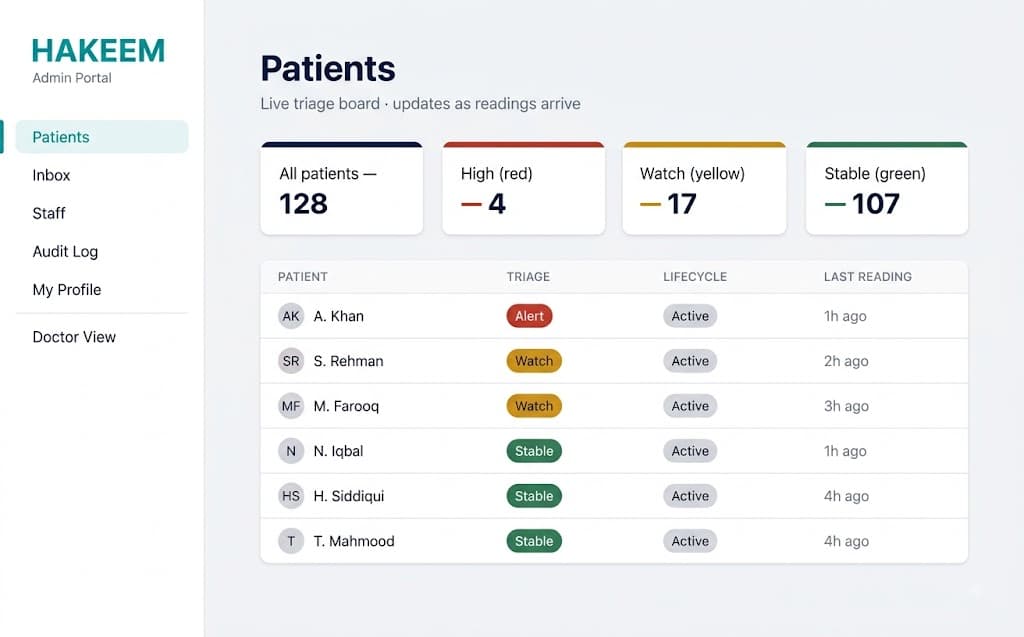
Green acknowledges itself and nobody is interrupted. Yellow raises a task. Red raises an urgent task and alerts the assigned counselor and every guardian on file at the same time.
The loop runs the other direction too.
It is not only reactive. The platform reads the patient’s actual prescription, turns it into a structured schedule under human verification, and sends one batched reminder per patient per time of day rather than one per drug. Appointment and payment reminders run on the same rails.
A family member paying for someone’s care, often from another country, gets a read-only view of that patient and a periodic report card.
The platform
Four capabilities. One platform.
Engage
LiveThe patient side.
Scheduled check-ins and vitals capture, medication reminders driven by the patient’s real prescription, appointment and payment nudges, guardian alerts and report cards, consent and opt-out handling.
“Your patients answer with one tap. No app to download.”
Desk
LiveThe team side.
Triage board, care pipeline, task queue, a human-in-the-loop WhatsApp inbox, billing ledger, an append-only audit log, and a separate surface for doctors.
“Your team sees only the patients who need a human.”
Scribe
Rolling outConsultation to structured clinical note.
Voice from a consultation or a counselor call becomes a structured note attached to the patient’s record.
“The note writes itself, and now it has readers.”
Copilot
Rolling outAI over the whole patient record.
Ask a question about a patient’s history, medications or past readings and get an answer from every encounter, not just today’s.
“Ask the record anything.”
Engage and Desk are the core. Scribe and Copilot attach to them.
Configuration, not code
We encode your care model. We don’t supply one.
Thresholds, message templates, reading parsers, escalation rules and check-in cadence are configuration. The platform runs a diabetes program in production today. The architecture does not know it is diabetes.
What you treat, how you treat it, and when you escalate stay yours. Clinical scope belongs to the provider.
Built so it cannot do the unsafe thing.
- No language model sits in the clinical decision path.
- Nothing reaches a patient off a machine’s reading of a document until a human confirms it against the source.
- Every action lands in an audit log the database itself refuses to change or delete.
- WhatsApp policy is enforced by the system, not by staff remembering it.
Instead of Hakeem
Everyone owns one layer. Nobody owns the stack.
The real alternatives, and where each one runs out.
- Keep doing it manually.
- Workable at fifty patients. At five hundred the inbox becomes the system of record, and the answer to “who is at risk right now” is somebody’s memory.
- Add headcount.
- It works, which is what makes it dangerous. Every new cohort of patients needs a new cohort of staff, and cost per patient never falls.
- Build it in-house.
- All of this is buildable. The parts that take the longest are the ones nobody scopes at the start: the messaging compliance state machine, the audit trail, the human review gates, and the rules for what happens when two doctors prescribe the same drug at different doses.
- Bolt generic tools together.
- A business messaging inbox is not a triage model. A records system is not a patient channel. Neither one knows what a red reading means or who to wake up about it.
Fit
Built for organizations that already run care.
- Chronic and continuous care programs
- Telehealth platforms
- Private hospitals running chronic clinics
If care is delivered by one person with no team behind them, there is no operation to run, and this is the wrong tool.
Show us how your care team works today.
If you are following more than a hundred patients between appointments, we will walk you through the loop against your own workflow. About twenty minutes.
Book a call